

Best of 2025: A Year of Writing and Recording

Last year, I reflected on publishing 14 articles and 49 podcasts. This year, I’ve written 17 articles and produced 85 podcasts.
Here are some of my top articles and podcasts from the year.
Top Three Articles
My most important article, in my humble opinion, was written in Mere Orthodoxy under the title Faithfulness in an Inside-Out World. They summarized it this way:
Andrew Noble critiques the "Inside-Out Approach," where personal desires outweigh external commitments. He argues this mindset fosters self-centered individualism, devaluing relationships and obligations. Noble contrasts this with a biblical view that prioritizes faithfulness over fleeting emotions, calling for a reorientation toward responsibility and commitment.
My best writing comes from my most patient thinking. I have been thinking about the concept of the “Inside-Out Approach” for years, applying it to my own life and to my teaching.
Similarly, I have long considered our difficulties in navigating social media (e.g., increased anxiety) to be itself an argument for Christianity. The lifelessness of technological idolatry leads to seeking life, and potentially finding it, in God.
Consider Deuteronomy 4:28-30:
There you will worship man-made gods of wood and stone, which cannot see or hear or eat or smell. But if from there you seek the Lord your God, you will find him if you seek him with all your heart and with all your soul. When you are in distress and all these things have happened to you, then in later days you will return to the Lord your God and obey him.
It is out of this interplay between our frustrations with technology and the hopefulness of heaven that I wrote Something Is Wrong, my most read article on Substack this year.
Something Is Wrong

We all know something is wrong with the world. But something is wrong with our technologies in particular.
Lastly, while I think many of my articles for TGC Canada were helpful and valuable, I had the most fun writing In Defence of Silly Summers.
One day, after my PhD is over, I’d love to explore the concept of fun in-depth. Not a blog post about joy, or a book about silliness, but an academic monograph on the biblical theology of fun. I may never get to this, so I hope someone else takes up the task.
In the meantime, in light of the holidays, consider reading:

Other notable articles:
My review of Work Out Your Salvation: A Theology of Markets and Moral Formation.
Are We The Idols? — an introduction to how we are shaped by idols and are like idols.
My advice for using social media and whether Jesus would use TikTok.
Why pastors should limit their use of Generative AI in sermon prep.
Also, my post “The Evolution of Isolation AI” had an attachment within it which links to my notes for when I teach on AI at churches.

Top Podcast Episodes
The podcast that I’ve received the most positive feedback on is the one I recorded with Bob MacGregor and Jon Cleland after the passing of Stan Fowler. He was a faithful man, to God, to his family, and to his students.
We recorded fifty-two episodes for “Thinking About the Faith,” a podcast which served as a delightful way to learn devotionally rich doctrine amid daily life.
Our episode on What is God? was my favourite. I hope to take all 52 weeks and upload them together to YouTube soon, which essentially would be a 13-hour course on the basics of Christian theology.
It was a big year for What Would Jesus Tech?
Not only have we been growing and attracting an increasing number of listeners, but we hired a podcast manager to free up some of my time.
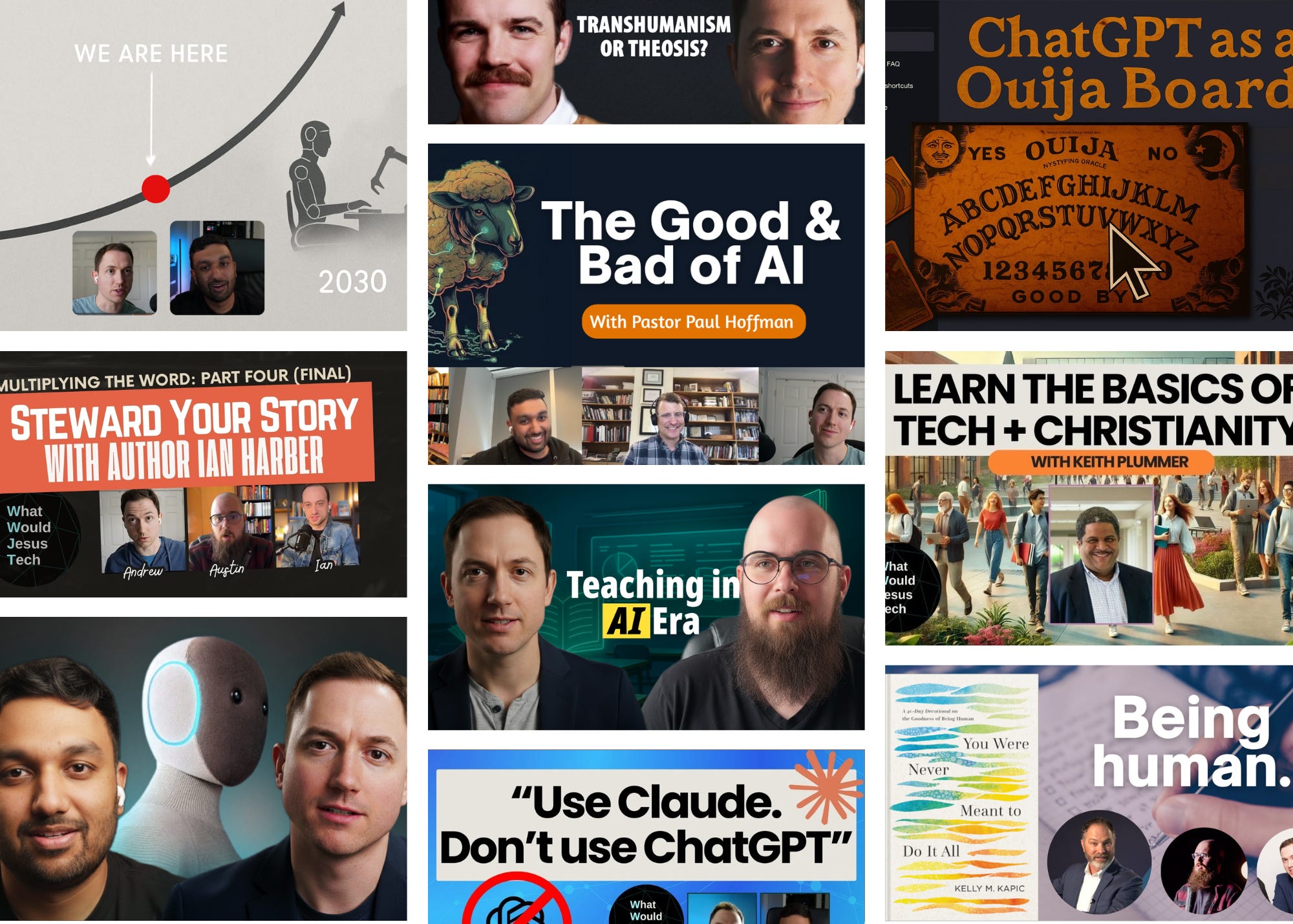
The best WWJT episode of 2025?
It’s hard to choose. Choosing and Using GenAI as Christians was one of the most popular (likely in part because of my very strong stance that Anthropic’s Claude is better than OpenAI’s ChatGPT) but I think Altman, Musk, and Belief in God was the best because it got to a deeper issue in our tech age: disenchantment.

It is also interesting, looking back on 2025, just how dominant Artificial Intelligence was. From demons, to the overhyped AI Bubble, to transhumanism, I’m really happy with what we covered.
You can find all episodes at https://www.whatwouldjesustech.com/all-episodes
Merry Christmas
Many are placing their hope in Superintelligence (or “AGI”) to solve the world’s problems. At the other extreme, in the midst of doomscrolling, it can be tempting to lack hope altogether.
I’ll end this post with a couple quotes from my cohost, Austin Gravley, who riffed off the idea of technological hope in our episode, Advent and the Technological Impulse.
We might say there is a material distinction between the coming of Christ and the coming of AGI. They are two different things. But our point is that these two different things are being discussed using the same language.
God's approach to solving our biggest problem — the existence of sin, the existence of death — he doesn't solve this problem in a way that we would prefer him to solve it. The advent of Christ shows us the humility of God... It's a sneak invasion, so to speak. God's way of dealing with our greatest problems is going to look different from how the world is going to want to do this — with impressive displays of wealth or knowledge or power. But those things will all fall short.
The advent of Christ, coming into the world to save the world, also prefigures his second advent.
Advent signals the eventual end of the ways in which technology can be used sinfully, or the way technology can exert itself against the Lord. And this coming of Christ in this first instance may not bring an end to that, but one day, [the second coming] will.