

Using GenAI: Benefits and Burdens
When should we delegate to AI?

Many years ago, I considered submitting an article for an essay competition. I had an idea but needed academic support. I googled scholarly research. I tried my University’s library search. Then I bounded around from one journal article to another. I had no context and got lost. I never wrote the essay.
Around the same time, I read an announcement from a Christian blogger about his upcoming book project. His project sounded interesting and I wondered, even though I was young, if I could help. Or maybe I could encourage him. I’ve never met him and I wasn’t sure what to say. I stopped writing the email.
Now in 2026, both of these tasks could be significantly supported by generative AI (GenAI) tools like ChatGPT, Gemini, or Claude. These tools would help. Is it okay for Christians to use them? I’ve come to think of it this way: for researching an article, yes; but for crafting an email, no.
This goes back to a rule of thumb made by Kevin DeYoung: it can be good to use GenAI for retrieving information, and potentially harmful for crafting it. We were created by our Creator in his image, our creativity is part of who we were made to be.

It’d be foolish to go to the gym and bring a machine to lift the weights for me. This is why limiting our use of GenAI makes sense. We reclaim our humanity when we choose to do the tasks we should. But it can get complicated. It can depend on your job, the way you use it, which tool you choose, and your spiritual maturity.
To help unravel the pros and cons of GenAI, I’ve started to think in terms of metaphors.
AI is like a Video Game
A video game is not inherently sinful. As Sarah Zylstra noted, playing games like Mario Kart can be a joyful outlet of creativity and exploration. Of course, it can also be a little self-interested (games are built around keeping you hooked), and it can disconnect you from day-to-day responsibilities. AI is like this too. It’s permissible within reason. But too much of it? That’s a waste of time.
I recently went back and forth with Gemini to create an image to promote a project I was working on. The image generator kept making mistakes even as it kept improving in other ways. I realized I needed to start from scratch and write a detailed and precise message to Gemini (this process is called “prompt engineering”). I decided to stop. I didn’t see the point. As Christians, we should “make the best use of the time” (Eph. 5:16), and sometimes these technologies waste it even while they promise to save it. As a recent HBR review has noted, AI doesn’t eliminate work, it intensifies it.
Wharton Professor Ethan Mollick has given some advice on prompt engineering and how to save time. This helps. But we should guard against using it as a distraction or as if it’s a person. Because prompt engineering is always changing, keeping up takes more and more time.
A lot of this depends on where you work. For some companies, it’s essential to be experimenting with GenAI. For others, it’s frowned upon or forbidden. Just as there is no command against driving a pretend car in Mario Kart, there’s no command against getting Apologist AI to tell you a dad joke. But that doesn’t mean the Bible is silent on whether or not we should be spending our time on these things. We must be thoughtful.

AI as Steroid and Digital Sherpa
I do not think GenAI is morally neutral. It’s a potentially dangerous activity, given that already, one in ten teens would rather talk to AI than a human. More AI tools are adding the ability to have “erotic” conversations; internal documents from Meta’s AI show how they allow bots to hold “sensual” chats with kids. Given that the top three uses of GenAI include therapy/companionship and “finding purpose,” Christians should be concerned about these idolatrous machines.
It’s a bit like a steroid, at least in some uses. When I was a kid I needed to take a kind of steroid for my asthma. Certainly, this was helpful. But most steroids negatively affect your health even as they improve performance. We shouldn’t underestimate those risks, and likewise, we shouldn’t understate the benefits.
The internet is a big place. It can be hard to find journal articles and pull together key information (whether recipes or location-based). The internet is like a mountain and GenAI is like a digital Sherpa who helps you navigate it. I’ve used AI tools to help me save money when navigating foreign public transportation, for example. GenAI can give good advice when used well.
A Sherpa is a climbing companion who carries supplies and guides the way. But of course, this analogy has a flaw. A Sherpa is human. These AI tools are not. It’s that falsifying of the image of God which is one of the key risks with these chatbots.
As soon as you start using these tools for one thing they trick you into thinking you can use them for more. “How do I make a cheese roux?” can easily turn into, “How do I deal with difficult in-laws?” ChatGPT is especially keen to adapt its “personality” to keep you talking to it. I agree with Noreena Hertz: people are using ChatGPT for too many tasks, like moral decisions and emotional support.
In 2 Kings 17:33 it says, “They worshiped the Lord, but they also served their own gods in accordance with the customs of the nations from which they had been brought.” I wonder if too many Christians are simply following the customs of our neighbours instead of reflecting on whether or not these tools are like steroids and idols.

GenAI as Help and Harm
Using GenAI might help you ace an essay writing contest, but at what cost? It can summarize the readings for you, but what will that do to your ability to reason and reflect? Research shows that whatever skills are offloaded to AI are eventually lost by the user (this is called “deskilling”). It can help. With the right methods, it can help a lot.1 It can also harm.
Because GenAI is so new, researchers are still learning about the negative side-effects. It’s always easier to see the benefits than the burdens.
Pray over your use of GenAI tools. Ask God to give you wisdom. Talk with people in your church about this. Read a good book by a Christian on AI (or two, or three). Don’t go with the flow, renew your mind. Keep your heart with all vigilance.
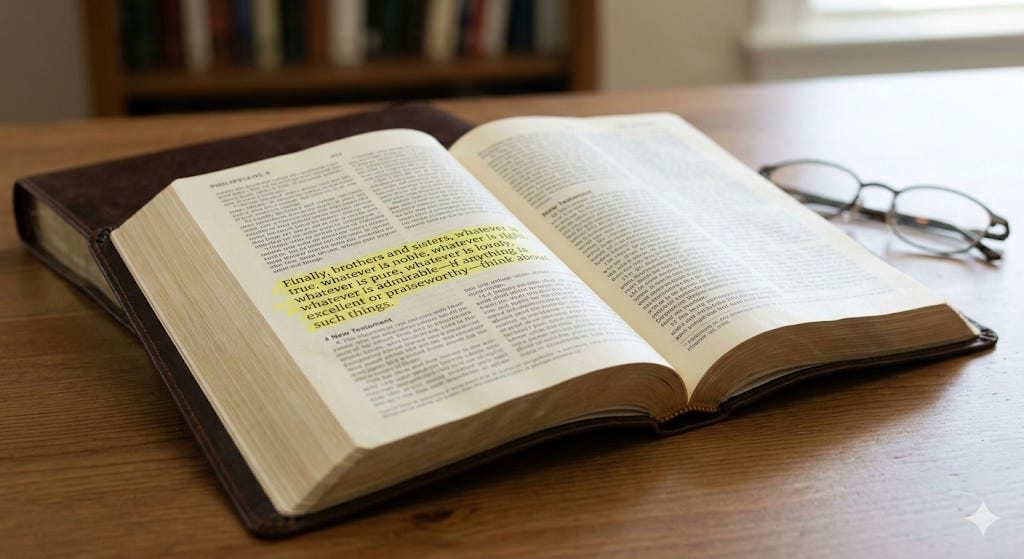
Generative AI is fun like a video game and helpful like a digital Sherpa, but the risks are real. It’s also like a steroid and a potential idol. Every AI app comes with biases (including with anti-Christian subjectivism). Christians must have their own bias: a bias toward whatever is true, whatever is good, and whatever is beautiful.
Be wise. Think on these things.
On using Generative AI well, a few thoughts based on my personal experience.
GenAI tools can “hallucinate” and present lies as fact. They still tend to share true information 95+% of the time. I say this with a few important caveats:
GenAI is more accurate with the most popular material (e.g., the main aspects of the history of the French revolution have been written about a lot… this is easier for AI).
GenAI is more accurate with less controversial material (e.g., since people debate whether or not Jesus is God, GenAI won’t give you a straight answer).
GenAI is more accurate with general themes rather than specific concepts (e.g. it may get the general themes of the French Revolution correct, while getting the date it began wrong.)
GenAI is more accurate with newer models rather than old, and more expensive research models rather than cheap and quick ones.
GenAI is more accurate with explicit prompting than vague requests.
In terms of which AI tools to use, this is changing every month. Currently, Google Gemini is one of the best image-makers, whether for photos, stock images, or infographic. Anthropic’s Claude is the best at administrative tasks, such as turning notes into powerpoint slides. Claude also found seven typos in this article. I tend to find value in Claude and Gemini. For me, I don’t tend to use ChatGPT due to their desire to keep me hooked (like an annoying video game) and their concerning moral history (e.g. people have left OpenAI due to ethical concerns).
This is very helpful. Brian recently used Claude to get advice on buying a new ipad, actually a refurbished one from Best Buy. There were several exchanges back and forth on the price and the usefulness for Brian's needs. He was very satisfied with his purchase.
I used Co-pilot to write 4 prayers based on specific scriptures for a service, based on the lectionary for Feb.8/26, that explored the effectiveness of recommended hymns and their ability to interpret the same scriptures. My minister, who is an excellent writer, is not sure she wants to take this path and I get it! For me, it was an experiment and an important time saver...I also had to communicate with my co-leaders and practice playing 10 hymns! (and spend a lot of time shovelling snow, I might add) There was no pressure to use the prayers that were generated but I did use them, word for word, adding emphasis where appropriate. Thanks, Andrew, for your thoughtful work.