

The Medium Is Not The Only Message
But it is important.

In Marshall McLuhan’s book, The Extensions of Man, he describes what he means when he says his famous refrain, “the medium is the message.” He explains:
This is merely to say that the personal and social consequences of any medium — that is, of any extension of ourselves — result from the new scale that is introduced into our affairs by each extension of ourselves, or by any new technology.
There is a lot going on here. We need to unpack it.
First, for McLuhan, the word “medium” is a placeholder for the concept of any extension of ourselves. And McLuhan uses “medium” interchangeably with what we normally call “technology.” A shovel is an extension of our hand. The car is an extension of our legs. A speaker is an extension of our voice. And so on.
Is he saying, “the technology is the message”?
Look again at his quote. Is he talking about a message at all? He is talking about the personal and social consequences of technology. He is saying that a technology change impacts everything. The new extension introduces “the new scale” and therefore there are a number of downstream effects, both personally and socially.
I hate to be so nitpicky about this, but it really can be confusing when you have a phrase like “the medium is the message” that people so readily wave their hand towards and assume we all know what it means. I’m not convinced most of us know.
Do you think McLuhan is actually saying, “the medium is the message,” or is he saying something else?
McLuhan’s explanation of his own catchphrase (as well the rest of his book) emphasizes that every medium has a message. That is the core truth in what he says. No medium or technology is neutral. Every technology has consequences, both personal and social. Of course this is what he means. He says it clearly and then goes through various technologies: clothing, housing, clocks, print, comics, and so on (chapters twelve through sixteen… as just an example).
In other words, “the medium is the message” is a rhetorical phrase to catch us off our guard. You think you have understood something by what it says. But you must also pay attention to the medium in which it says it.
It’s an effective communication tactic. There is a message in the medium. I agree with that. But it is not the only message. It does not mean that the underlying original message (the “I love you” note, sent either through text message or verbally) is actually that different.
In other words, I do not think that the medium is actually the message. It’s certainly not the only message. The early church, for example, changed the Scriptures from being written on a scroll to being written in a codex (a precursor to the modern book, with pages). The Scriptures still contained the same message even though they were delivered in a different medium. That new medium certainly had certain personal and social consequences, but the same message carried through.
And so I do not believe “the medium is the message” except in the rhetorical and evocative sense. Or if by saying it you mean, “the medium is the message that we should pay more attention to,” but not if you mean, “the medium is the only message.”
Many people are welcome to speak in such ways. It’s memorable. But I tend not to repeat the phrase “the medium is the message” because it can be confusing. The medium is not the only message (but to be clear, McLuhan is still worth reading). And so, in my laws of technology, I say that “technology changes you.” This states one of the underlying points made by McLuhan more clearly: there are personal consequences to every technology.
And this brings me to Artificial Intelligence.
What is the medium of Generative AI?
I will have more to say later this year about the messages contained in Generative AI tools such as ChatGPT and Gemini.
But what about the medium?
I have thought about this question for months. And I’ve come to a conclusion. The medium is the chatbot.
I’ve written a long article (I’m thankful for Mere Orthodoxy for publishing it!) and you can read it for free right now through the link below.

Links to Podcasts I’ve Cohosted
The What Would Jesus Tech podcast is mostly on a summer hiatus. Though we do have a special episode to be released soon, with a special guest appearance, on the topic of technology in 1776. It’s a good one. Subscribe so that you do not miss it.
My church’s Thinking About It podcast continues to upload weekly episodes, mostly around twenty minutes in length. We’ve changed the format from cutting things off at fifteen minutes to ending the conversation when it’s worth ending.
Here are the links:
Thinking About It | Season 5: Live Like a Christian (Links: Website | Apple | Spotify):
Is Our Dependence on Cars Making Us Lonely?
Christian Approaches to IVF
Tattoos, Transhumanism, and Technology
Parenting and Social Media
What Would Jesus Tech (Links: Website | Apple | Spotify | YouTube):
Books About Building for the Age of AI
Thanks for reading.
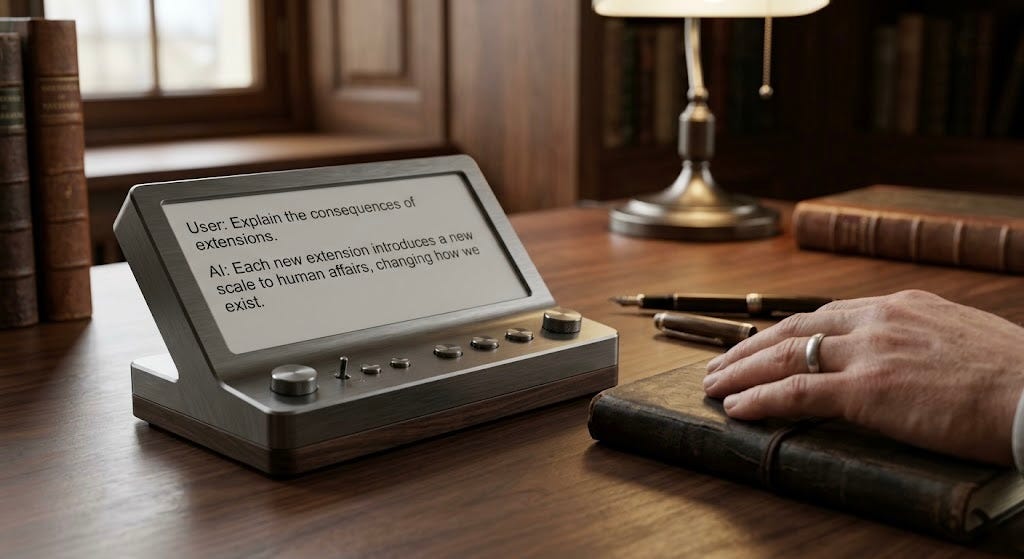
I asked Google Gemini for an image. At first I said, “create a simple substack image for this post. no words. it should evoke interest without being clickbait. simple idea without being cheesy. colour is good.” And then I gave it this entire post. It actually gave me something I didn’t like, so I responded, “try again. go with a completely different idea. no cartoons. go more realistic.” And then it gave me the image above. If I had to rank it, I’d give it a 4.6 out of 7.
There is some irony in the fact that all Substack posts on the internet must (by common thought) have an image to go with them, not to mention the fact that I used AI to make it. The medium of images alongside text is a phenomenon worth exploring. Are we all just wishing we could be children again and have picture books? What if every chapter in a book began with an unsplash photo? How would that change your perspective of the book? Is the medium the message?